
The new plan for Ilford wants 6,000 homes by 2050. Its own audit says 784 were built after 2018 and half of tall schemes are stalled. Comments close 30 October.
A 171-page plan for the next 25 years of Ilford town centre went out for public comment on 17 September, and the most striking number in it is not the one the council put in its press release.
The draft Ilford Opportunity Area Planning Framework, written by the Greater London Authority with Redbridge Council and Transport for London, proposes 6,000 new homes and 1,200 new jobs in Ilford by 2050.
Ilford was designated an Opportunity Area in 2004. The framework says the designation then carried “the potential of delivering 6,000 homes and 700 jobs by 2041”. Twenty-two years on, the housing number is unchanged and the finishing line has moved back nine years.
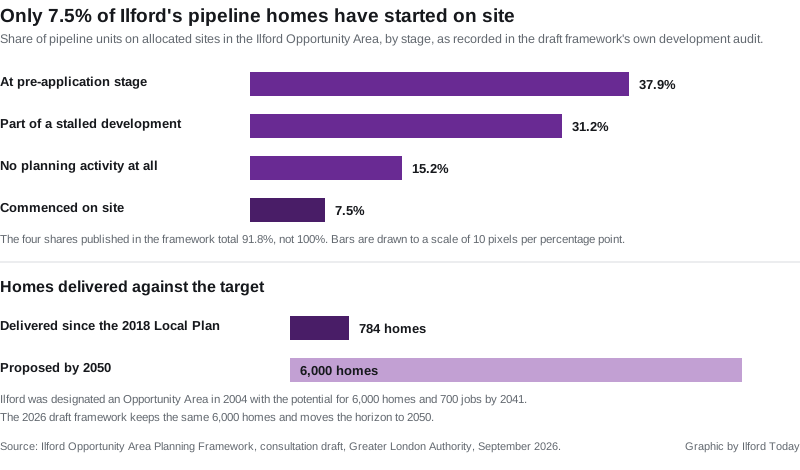
The framework is blunt about why. “Since allocation in the 2018 Local Plan, only 784 homes have been delivered.”
What its own development audit found
The draft contains an audit of every site allocated for development in the Opportunity Area. It is the most useful page in the document, because it counts what has actually happened rather than what was approved.
Of the pipeline units on those sites:
- 37.9 per cent are at pre-application stage
- 31.2 per cent are part of a development the framework calls “stalled”
- 15.2 per cent are on sites that have shown no planning activity at all since being allocated
- 7.5 per cent have commenced on site
The same page notes that the proposals that have come forward, on their own, would bring around 5,000 new residents into the town centre.
Towers are the plan, and towers are what is stuck
The heights strategy puts the tallest buildings, 24 storeys and above, in the town centre and at the most transport-accessible spots. Blocks of 16 to 24 storeys cluster around Ilford station, 8 to 16 storeys form what the draft calls the predominant character of the area, and anything up to 8 storeys sits at the edges, stepping down towards the surrounding streets.
Then, a few lines later, the framework says this:
Tall buildings in Ilford face significant viability challenges, with half of schemes over 6 storeys currently stalled and none completed.
Its answer is that “in the short to medium term, higher-density mid-rise development may offer a more deliverable route to growth”. That is a substantial qualification on a strategy built around tall buildings, and it is not in any press release.
The draft lists the reasons growth has been slower than anticipated: a shortage of large, development-ready sites in single ownership; fragmented land ownership; low residential values against construction costs; Building Safety Act requirements; and infrastructure contributions. It says demand for new-build homes at the price points those tall schemes need “remains limited”.
A new town square, and what it would cost the Kenneth More Theatre
The framework says Ilford “lacks a clear civic focal point” and sets out two options for a public square.
Option A puts a square on the High Road opposite the Town Hall, alongside a renewed Town Hall with a wider civic, cultural and community offer. The draft is candid about the catch: “as a minimum, delivery of a new square in this location would require the redevelopment of 171-175 and 177-185 High Road”, and “delivery is highly dependent on land assembly and redevelopment coming forward, which presents a significant implementation risk”. It proposes a phased approach that starts with clearing market stalls from the stretch in front of the Town Hall and adding trees, seating and play equipment.
Option B is the one Ilford should read twice. It proposes “comprehensively redeveloping the Kenneth Moore Theatre alongside the Town Hall”, creating a multi-functional venue with community rooms, flexible performance spaces “and much-needed homes above”, plus a smaller square of roughly 50m by 25m on the High Road.
The theatre’s name is spelled Kenneth More, after the actor. The framework describes it as “an important sub-regional cultural asset” and “a notable example of Brutalist design”, and says re-providing it inside a mixed-use development, with housing above and better cultural space at ground level, “could ensure its long-term viability and broaden its offer”.
There is a timing problem with that. The draft describes the theatre as “currently closed and undergoing roof repairs”. On the same day the consultation opened, the council announced that the Kenneth More reopens in December after more than £1m of RAAC removal and refurbishment, with new seating, redecoration and new carpets.
So a framework the council has co-authored is consulting on replacing a building the council is about to reopen. Nothing in either document explains how the two sit together, and Option B carries no cost, no timescale and no commitment: the draft presents it as one of two ways of getting a civic square, not as a decision.
The Ilford the framework describes
The draft’s own portrait of the town is worth reading whatever you think of the proposals. It records that:
- 42,243 people live in Ilford
- it is more deprived than 92 per cent of neighbourhoods in England
- 25 per cent of the population is under 15
- 55 per cent of people living in Ilford are economically active, below the London average
- 35 per cent of workers living in Redbridge work at night, among the highest shares in outer London, and most of them live in and around Ilford
- 64 per cent of residents identify as Asian or South Asian
- average household size is 2.9, above the London average
- 20 per cent do not have English as a first language
It also says community provision is “heavily reliant on faith-based venues that often serve specific sections of the community”, and that Ilford “lacks dedicated spaces for young people despite its youthful population”.
The seven places it splits Ilford into
The second half of the document works through seven areas with a separate vision for each: Ilford Hill, Ilford Approach, Cranbrook Road, Central High Road, Clements Road, Ley Street and High Road East.
The short version of each:
- Central High Road: the new civic heart, with the town square, taller buildings near the station and homes above active ground floors.
- Clements Road: civic, cultural and creative uses consolidated around the Town Hall and the Kenneth More Theatre, with new housing.
- High Road East: the eastern gateway, with taller buildings along the railway corridor and at Griggs Approach, and a potential new town park.
- Cranbrook Road: the station-to-Valentines Park corridor, with public realm work, safer cycling and “sensitive infill development” rather than towers.
One number to watch for
The council’s press release says 1,200 new jobs. The framework’s key diagram and its economy chapter say 1,200 too. Its executive summary says “around 6,000 new homes and 1,000 to 1,300 jobs”. The range is the honest version of the round number, and it is the first page of the document.
What it means for you
The consultation closes on Friday 30 October 2026. Everything is on ilfordoapf.commonplace.is, including the full draft framework, a shorter Action Plan, the evidence base, the capacity study and the impact assessments. There is a full survey, a quick survey and a map you can drop a pin on.
Four drop-in events are listed, and the first is this week:
- Ilford Station drop-in: Tuesday 22 September, 1pm to 7pm, at Ilford station.
- Business drop-in: Tuesday 29 September, 12pm to 3pm, at The Hub in the Exchange shopping centre, third floor, next to the NHS health centre.
- Online drop-in: Monday 26 October, 5.30pm to 7pm.
- Library drop-in: Tuesday 27 October, 3pm to 8pm, at Redbridge Central Library.
A few practical points on what this document is and is not:
- It is not a planning application and it does not grant permission for anything. It is London Plan guidance, intended to steer decisions on individual schemes once it is adopted.
- Feedback goes towards the final version, which the council says will be adopted in 2027.
- If a specific site near you matters, the place chapters are where to look: each names the streets it covers and the building heights it would support.
- The heights strategy is indicative. Individual schemes will still come to Redbridge’s Planning Committee, where you can speak in person if you contact the committee support officer by 5pm the working day before.
- The framework was written before the borough’s latest housing delivery figures went to committee. In reports this month, Redbridge officers put the council’s Housing Delivery Test result at 30 per cent, which they describe as the second worst housing delivery of all 33 London boroughs.
Sources
- Ilford Opportunity Area Planning Framework, consultation draft, Greater London Authority, September 2026, the 171-page draft, for the 6,000 homes and 1,200 jobs by 2050, the 2004 designation with 6,000 homes and 700 jobs by 2041, the 784 homes delivered since the 2018 Local Plan, the development audit percentages, the 5,000 new residents, the heights strategy, the tall buildings viability passage, the town square options A and B, the Kenneth More Theatre passages, the Ilford at a glance statistics and the seven place chapters.
- Have your say on the future of Ilford, Redbridge Council, published 17 September 2026, for the launch, the 1,200 jobs figure, the 30 October closing date and the 2027 adoption date.
- Ilford OAPF consultation hub, for the four drop-in events and the consultation documents.
- Redbridge Planning Committee reports, September 2026, published on moderngov.redbridge.gov.uk, for the 30 per cent Housing Delivery Test result.
Have your say