
The stillbirth rate at Queen's Hospital's maternity service fell from 5.24 to 2.62 per 1,000 births. Nearly half of Redbridge babies there were born by caesarean.
The stillbirth rate for births at Queen’s Hospital in Romford has halved since 2024. The trust that runs it says both stillbirths and newborn deaths are at their lowest in four years.
The figures are in a maternity update from Barking, Havering and Redbridge University Hospitals NHS Trust (BHRUT). It goes to Redbridge Council’s Health and Care Scrutiny Committee on Tuesday 24 November.
Queen’s, about five miles east of Ilford town centre, is where BHRUT’s labour ward and Birth Centre are.
Overview
- Stillbirths: 2.62 per 1,000 births from January to August 2026, down from a peak of 5.24 in the same months of 2024.
- Newborn deaths: 0.66 per 1,000 live births, down from 1.27 in 2025.
- Redbridge births: 1,515 of the trust’s 5,654 deliveries from January to October 2026.
- Caesareans: 44.7% of Redbridge births and 46.3% across the trust. In 2018 the trust figure was 29.1%.
The figures for Redbridge mothers
BHRUT delivered 5,654 babies between January and October. Of those, 1,515 were to Redbridge mothers, and 678 of them were born by caesarean section.
The trust’s report compares Redbridge mothers with those from its other areas over the same ten months:
| Measure | Redbridge | All other areas |
|---|---|---|
| Diabetes (all types) | 24.4% | 18.3% |
| Obesity (BMI at booking) | 24.7% | 18.3% |
| Emergency caesarean | 30.1% | 27.8% |
| Elective caesarean | 14.7% | 18.5% |
| High medical risk in labour | 31.9% | 31.4% |
| Stillbirths | 0.5% | 0.4% |
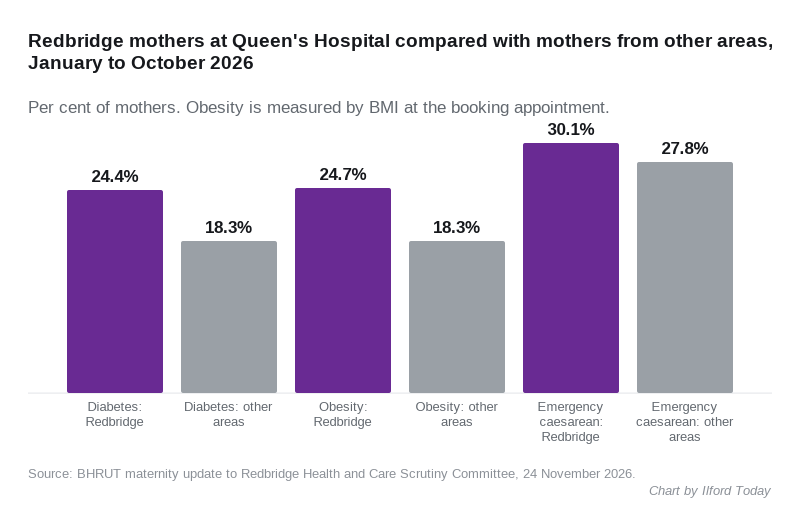
The trust lists more complex pregnancies as one of its main pressures. It names rising rates of obesity, diabetes and high blood pressure. It also says half of its mothers do not speak English as their first language.
Two-thirds of Redbridge mothers (66.73%) were from an Asian background, against 41.83% across the trust.
What has changed
The trust says it has cut its midwife vacancy rate from 16% in 2023 to 7%. It also lists:
- a dedicated consultant in obstetric triage, which it says few units have
- 24-hour “flow” coordinators to cut delays
- out-of-hours theatre sessions and more theatre staff, including overnight, to cope with the rise in caesareans
- bilingual antenatal classes and bilingual volunteers
In IG1, one of three areas where it set up dedicated continuity of care midwife teams, there were four losses from 24 weeks of pregnancy in the first three months of 2024. From April 2024 to March 2026 the figure was between none and two each quarter, the report says.
The Care Quality Commission rated the service Good in August 2025. The trust has also left the national Maternity Safety Support Programme.
What families told the national review
BHRUT was one of 12 trusts in the Amos Review of maternity care. Its own report from that review found seven themes. Among them, families described concerns about pain and reduced baby movements being minimised, and defensive answers to complaints.
The other themes the trust lists are:
- crowded triage, with women unsure when they would be seen
- unequal or disrespectful care for some women, and unreliable interpreting
- staff workload and fatigue
- only two theatres and limited neonatal space; the trust has no level 3 neonatal intensive care unit, so babies who need that care are transferred
- paper records, with an electronic patient record still being introduced
For each, the report sets out what the trust is doing, from complaint response training to extra interpreting support.
A separate NHS North East London update to the same meeting says NHS England reviewed 26 parts of BHRUT’s plan in October. It agreed with the trust’s own rating on 19. The trust must send more evidence on the other seven in its December return.
After the Thirlwall inquiry, CCTV covering where insulin is stored on the neonatal unit is on track to be installed by 30 November, the trust says.
What it means for you
BHRUT offers a choice of the labour ward, the midwife-led Birth Centre or a planned home birth. The trust takes self-referrals for pregnancy care online.
Barts Health, which runs Whipps Cross Hospital in Leytonstone, sent its own report. Its Whipps Cross maternity report to the committee says its maternity triage action plan is due in December 2026.
The committee meets at 7pm on Tuesday 24 November in the Council Chamber at Ilford Town Hall. The agenda includes public question time.
Have your say