
Three neighbour objections or a councillor's call-in can force a public planning hearing today. From 31 October neither can. Councillors vote on it tonight.
If three of your neighbours object to a planning application in Redbridge today, that can be enough to put it in front of eleven councillors at a public meeting. So can a single letter from your ward councillor asking for it. From 31 October neither will count for anything.
Full Council votes tonight on the constitution change that does it. It is item 10c on the agenda, and the officer report says it in one line: “There will no longer be a general right for Members to call-in applications for committee consideration.”
The council has no choice about the principle. The change is forced by the Town and Country Planning (Discharge of Local Planning Authority Functions) (England) Regulations 2026, SI 2026/854, made on 15 July and in force on 31 October. It applies to applications that are already live. What the council does have a choice about is how far to go beyond the minimum, and Redbridge has chosen to go further.
What changes for a resident
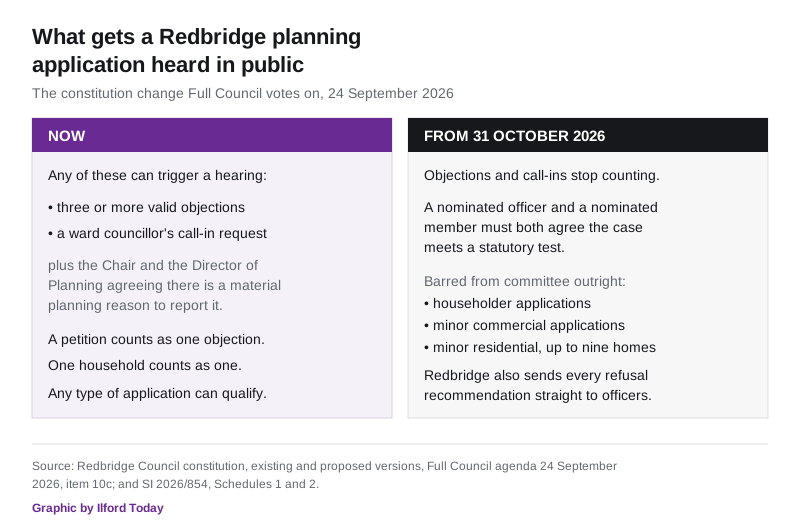
The current constitution is specific. A planning application recommended for approval goes to committee where there are three or more Objections or a Call-In Request, and where the Chair, in consultation with the Director of Planning and Building Control, agrees they meet the definitions and that there is a material planning reason to report it.
Both terms are defined. An Objection has to be named, not anonymous, from someone living or trading at a Redbridge address, submitted inside the statutory consultation period, and raising material planning considerations. Several objections from one household count as one. A petition counts as one. A Call-In Request has to come from a councillor in the ward or an adjoining ward, inside the same window, and must contain “a specific request for the application to be considered by Committee”. A councillor who simply asserts that the committee should see it, “without a proper planning reason as to why”, is refused.
In the version councillors vote on tonight, those two definitions are deleted from the constitution entirely. Nothing replaces them.
What replaces the route is the regulations’ gateway. An application reaches committee only if a nominated officer and a nominated member both agree that referral is necessary, and only if it falls inside Schedule 2 of the regulations. Schedule 2 excludes householder applications, minor commercial applications and minor residential applications, the last of which means one to nine homes on a site under half a hectare. So most of the everyday applications a neighbour objects to cannot reach a committee at all, whoever asks.
Government guidance sets the test the two of them have to apply. At a minimum, one of these has to be met:
- the application raises an economic, social or environmental issue of significance to the local area
- the application raises a significant planning matter having regard to the development plan and any other material considerations
In Redbridge, the report says, that pairing already exists in practice. The council runs what it calls a “Chairs Action” meeting between the Chair of the Planning Committee and the Director of Planning and Building Control, with the Vice Chair and the council’s Development Manager able to deputise. Under the new rules the same two roles become the statutory gatekeepers.
Where Redbridge goes further than it has to
The regulations let a council decide which Schedule 2 categories go through the gateway at all. Redbridge’s report recommends sending several straight to officers instead:
- listed building applications, other than major applications
- tree applications
- advertisement consent
- section 106 modifications and discharges
- any application where the officer recommendation is for refusal
The first four are already delegated today, and the report says the national scheme would have allowed them to be gateway-tested instead. The last one is new and is the one worth noting. It means that from 31 October, where planning officers intend to refuse an application, nobody can ask for that decision to be taken in public by councillors.
The report’s stated reason is workload: these measures “would ensure that the Nominated Member and Nominated Officer are not overwhelmed and to avoid unnecessary delays”.
Two other points from the report. The regulations cap a planning committee at 13 members; Redbridge has 11, so nothing changes there. And mandatory training for committee members, trailed as part of the reforms, “is not brought into force by this package”.
Speaking rights survive, because a committee asked
Residents do not lose the right to speak. They lose the route to a hearing, not the microphone.
That distinction nearly went wrong here. The old rule gave a speaking slot to “any Ward Councillor who has submitted a Call-In Request”, and call-in requests are being abolished. The General Purposes Committee, which looked at the changes on 16 July, endorsed them subject to one amendment: that ward member speaking rights “are clarified so that the existing rights remain”. The redrafted clause now gives a slot to any ward councillor from the ward the application is in, or an adjoining ward, up to three of them, two minutes each.
Public speaking otherwise stands as it is. Up to three objectors can address the committee for two minutes each, the applicant gets a slot of matching length, and anyone who wants to speak has to register with Democratic Services by 5pm on the working day before the meeting.
One loose end is visible in the papers. The redrafted constitution still gives the objector slot to people “who have submitted an Objection (as defined above)”, while the section that defined an Objection has been removed from the same document. The recommendation councillors are asked to approve authorises the Monitoring Officer “to make consequential non-substantive corrections”. The changes were reviewed by the council’s Monitoring Officer and by the external law firm Sharpe Pritchard.
How much this actually moves in Redbridge
Less than the wording suggests, and that is the point worth making.
Government figures show Redbridge already sends almost nothing to its committee. In the year to March 2026 the borough made 1,673 planning decisions and delegated 100% of them to officers, rounded to the nearest whole number, in MHCLG live table P134. The figure for London as a whole is 97%, and for England 96%. Only one other London borough, Merton, also rounds to 100%, and it made fewer decisions than Redbridge did.
The committee’s own diary says the same thing. The constitution allows for 11 meetings a year. It has met six times in 2026: on 4 February, 11 March, 15 April, 10 June, 15 July and 16 September. Two more are listed, on 14 October and 10 November, which makes 14 October the last Redbridge planning committee held under the current rules.
The last agenda before the change
The three applications the committee heard on 16 September show how applications actually reach it here, because each officer report states the reason on its first page.
- 1516/26, 10-11 Janice Mews, Ilford, a change of use to a voluntary sector community hub. Called in by: N/A. Objectors: N/A. It was there because “officers do not have the delegated powers to determine applications made by the Council, or in relation to land owned by the Council, which are not in-line with statutory functions”.
- 1822/25, 142 Hermon Hill, South Woodford, nine flats over a commercial unit on the site of a former pub. 124 objections and three in support. No call-in. It was there because the Chair and the Director agreed it raised “issues of a complex nature and local interest”.
- 0249/26, 13 Granville Road, Ilford, a retrospective change of use to a large house in multiple occupation. Three objectors. No call-in. Same reason: the Chair and the Director agreed it had “a complexity and significant local interest”.
So the route being abolished was not the route any of them used. All three arrived through the Chair-and-Director pairing that survives, renamed. The one that does change is Janice Mews: the report going to Council tonight includes “a minor change that will allow all small Council applications to be delegated”, so the council’s own small schemes need not reach a public committee in future.
We reported all three at the time: Janice Mews, Hermon Hill and Granville Road.
What it means for you
- Objecting to a planning application still matters. Officers have to take material planning considerations into account whoever decides. What changes is that the number of objections no longer opens a route to a public hearing.
- If your complaint is about a house extension, a small commercial scheme or a development of between one and nine homes on a site under half a hectare, it cannot go to committee after 31 October whatever anyone does. Those are Schedule 1 in the regulations, and Schedule 1 must be decided by an officer.
- Asking your ward councillor to call an application in stops working on 31 October. Asking them to write in support of a referral still does something, because the nominated member is the committee chair.
- If officers are minded to refuse something you object to, you will not be able to ask for that to be decided in public.
- Applications already in the system are covered. The regulations have no transitional provisions, so live applications switch to the new rules on the day.
- The committee still meets in public and you can still speak at it. Register with Democratic Services by 5pm the working day before.
Track applications in the borough on our Ilford planning news page, and see what is closed this week on Ilford roadworks and travel.
Have your say