

Cabinet approved Redbridge's SEND strategy on 22 October. Care plans for primary pupils are up 60% since 2022 and forecast to reach 2,351 by 2030.
Redbridge Council’s Cabinet has approved a new four-year strategy for children with special educational needs and disabilities (SEND). It comes 16 months after inspectors found “widespread and/or systemic failings” in the borough’s support for them.
The council Leader, Cllr Kam Rai, confirmed the decision in his update on Friday 23 October. Cabinet approved the SEND and Alternative Provision Strategy at its meeting the evening before.
The papers behind it, published with the Cabinet agenda, show how fast demand is growing. The number of children holding an Education, Health and Care Plan (EHCP) has risen in every age group since 2022, even where the child population has fallen.
How many children now have a plan
The council’s SEND demand overview, dated June 2026, counts the plans held in May 2026:
| School phase | Plans, May 2026 | Rise since 2022 | Forecast for 2030 |
|---|---|---|---|
| Primary (Reception to Year 6) | 1,808 | 679 (60%) | 2,351 |
| Secondary (Years 7 to 11) | 1,158 | 314 (37%) | 1,673 |
| Post-16 (Years 12 and 13) | 390 | 130 (50%) | 594 |
That is 3,356 plans across the three phases now, and 4,618 forecast by 2030.
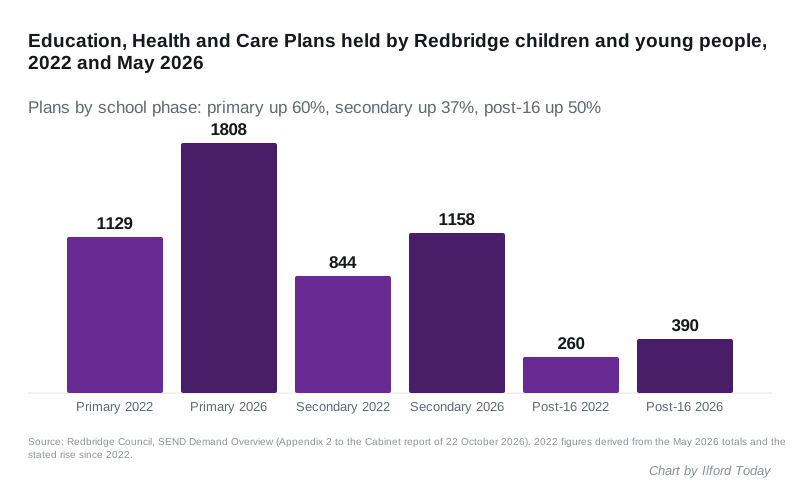
The rise is not simply more children. Redbridge’s primary-age population fell by 1,216 between January 2022 and January 2026, to 29,052. Over the same period the share of primary pupils with a plan went from 3.7% to 6.2%.
The council’s own conclusion is that this “demonstrates rising need and complexity, not just population growth”.
Three kinds of need drive most of it:
- Primary: autism (44%) and speech, language and communication needs (39%) account for 83% of plans.
- Secondary: speech and language (34%), autism (28%) and social, emotional and mental health needs (17%) account for 78%.
- Post-16: autism (30%), speech and language (26%) and mental health needs (18%) account for 74%.
Need is not spread evenly. The overview puts the highest primary demand in the east and south of the borough, and the highest secondary demand in the north and north-east. Five wards hold about 35% of the post-16 group. The ward names appear only on maps in the document.
Why the council needed a strategy
Ofsted published the findings of its area SEND inspection of Redbridge on 30 June 2025. The Department for Education issued an Improvement Notice on 3 September 2025.
The inspection set out four priority actions, which the strategy repeats in full. In short, the council and NHS partners had to:
- urgently improve the data used to plan services
- build genuine co-production with children and parents, so families’ voices shape the support
- create a joint plan for preparing young people for adulthood
- fix communication and information-sharing between services
The Cabinet report says 80 of the 175 actions in the improvement plan were complete by August 2026.
The seven priorities to 2030
The strategy runs from 2026 to 2030 and sets seven priorities:
- Child and family voice, and communications
- Early identification, and the speed and quality of EHC assessments
- An early intervention support offer
- Preparing for adulthood
- Children out of school, and alternative provision
- Local specialist provision, commissioned jointly with the NHS
- Shared SEND data across the partnership
The Leader wrote that its “simple ambition” is for children with SEND to get high-quality education and support “as close to home as possible”.
What has improved, and what has not
The Cabinet report gives these gains since the inspection:
- 48% of new plans were issued within the legal 20 weeks over the last 12 months. That is above the national figure of 46.1% for the first time. The improvement plan records a baseline of 22% in September 2025.
- Eight children were waiting more than 30 weeks for a plan in June 2026, against 47 in June 2025.
- 38 children were recorded as missing from education in July 2026, after a review the council says cut the number by more than 90%.
The report is just as clear about what is still behind. It names annual reviews, health advice for assessments, staff recruitment, rising demand and preparation for adulthood.
The improvement plan shows the scale of the annual review problem. In September 2025, only 10% of annual review decisions were made within four weeks of the review meeting. The target is 50% by March 2027.
Therapy waits had the same starting point. In September 2025 the share of children seen for a first contact within 18 weeks was:
| Service | September 2025 | Target |
|---|---|---|
| Occupational therapy | 58.1% | 92% |
| Speech and language therapy | 69.4% | 92% |
| Physiotherapy | 74.5% | 92% |
The report also says an August 2026 stocktake with the Department for Education found families were “not yet consistently and effectively involved” in shaping services.
What it means for you
- Your rights have not changed. The report’s legal section says the strategy “does not replace or reduce any existing individual statutory entitlement”. Support in mainstream school “must not operate as a barrier” to an EHC needs assessment where the legal test is met.
- New plans should come faster. The council’s stated aim is that no child waits more than 30 weeks.
- Annual reviews are still slow. If your child’s review decision is late, the improvement plan shows the council knows it is behind.
- More specialist places are planned. The report calls special school capacity “a specific local risk”. See our coverage of New Rush Hall School’s expansion and the council’s school places plan.
The report notes that Cabinet decisions “may be called in” for review by councillors. The council had not published its formal decision notice when we checked on 29 October.
The Children and Education Scrutiny Committee next meets at 7pm on Tuesday 3 November.
Have your say